
Spotiguess : Music Quiz
RicoCorpMusic
4.49.00 Reviews
- Version
- 1.4.2
- Installs
- 50.00K
- Age Rating
- Everyone
Screenshots
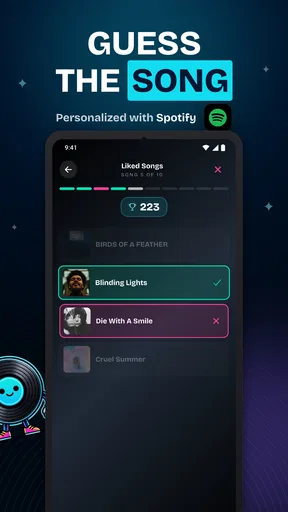
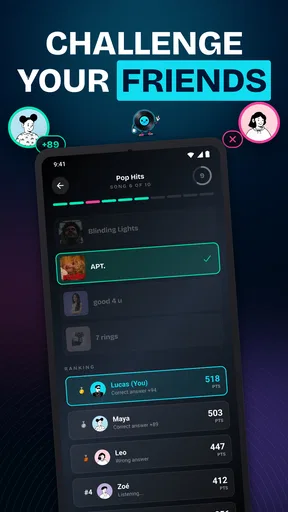
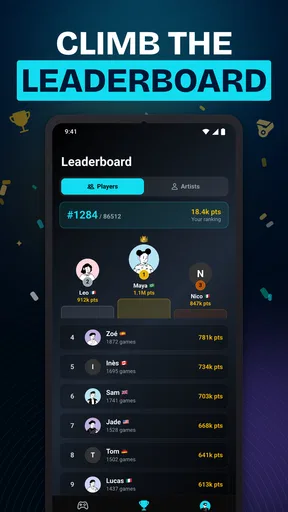
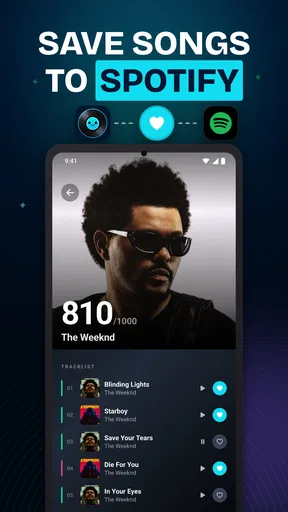
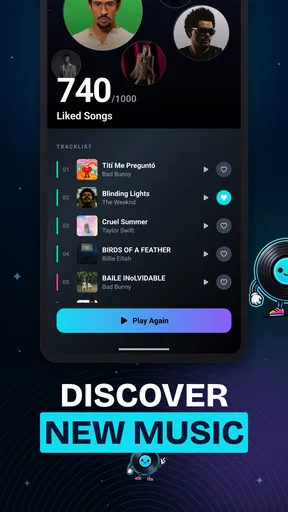
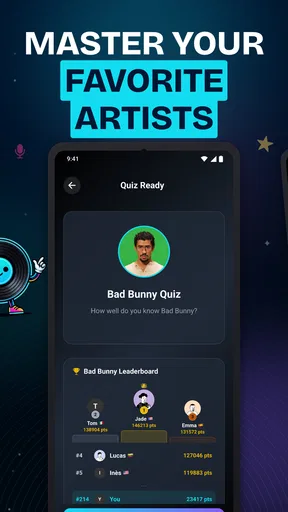
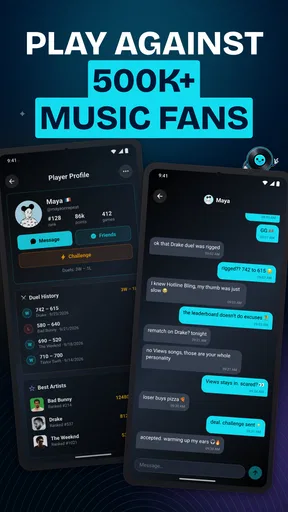
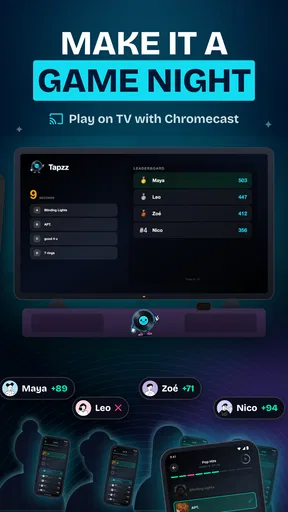
Our Review of Spotiguess : Music Quiz
 Analysis by Appyee
I spent time with Spotiguess, a free music quiz game from RicoCorp, and its appeal became clear within the first few rounds: it turns recognizing a song into a quick test of memory, attention, and confidence. The idea is simple, but simplicity is exactly what makes this kind of game easy to pick up when I have a spare moment. I do not need to prepare a playlist or learn complicated controls. I can open it, listen, make a guess, and move on.
That straightforward design also gives the game a specific identity. It is not trying to replace a music-streaming service, teach music theory, or offer a long narrative campaign. It is built around the small satisfaction of hearing something familiar and naming it before hesitation gets in the way. In my experience, that makes it especially suitable for short sessions, casual competition with friends, or a relaxed way to test how well I actually know the music I enjoy.
How the first goals shape the experience
The early goal is obvious but effective: identify songs correctly. That gives every round an immediate purpose, even when I am only playing for a few minutes. The game does not need a large tutorial to explain the basic attraction. I hear a musical clue, search my memory, and decide whether my first instinct is right. The tension comes from the gap between recognition and certainty.
That distinction matters. A song can sound familiar without its title arriving instantly, and the best moments come when the answer clicks just before I commit. I found myself paying attention to details I might normally ignore, such as an opening rhythm, a vocal texture, or a distinctive musical phrase. The quiz format makes listening feel active rather than passive.
For a new player, the most sensible approach is not to rush every answer. I get better results when I use the opening seconds to identify broad clues first: the likely era, style, singer, or mood. That mental filtering is more useful than randomly cycling through titles. It also makes mistakes feel informative, because I can tell whether I confused two artists, recognized the melody but forgot the name, or simply guessed too early.
The game works well in everyday situations where a larger game would be inconvenient. I can imagine playing during a short break, passing a phone around at a small gathering, or using it as an informal music challenge with someone who claims to know every song. A round does not require the same commitment as a full console session. That low entry cost is one of its strongest qualities.
At the same time, players who want a deep music database, a carefully structured lesson plan, or a substantial solo adventure should adjust their expectations. The pleasure here comes from repeated recognition challenges, not from exploring a world or building a character. If that core loop does not sound appealing, extra play will not transform it into a different genre.
Small targets make short sessions worthwhile
I like that the immediate objective is easy to understand, but the longer-term motivation depends on how much I enjoy improving my own recall. Each correct answer can feel like a tiny personal win. I start noticing patterns in my performance: songs I know from the first clue, songs where I need a moment, and songs that expose gaps in my listening habits.
That creates a useful personal challenge without requiring the game to make exaggerated promises. I can set my own informal goals, such as trying to avoid impulsive guesses, improving a weak musical area, or seeing how consistently I can identify tracks when playing with friends. These goals are not the same as a formal progression system, but they help the basic quiz remain meaningful beyond the first few rounds.
One practical tip is to treat uncertainty as part of the game rather than as a reason to become frustrated. When I am unsure, I try to separate recognition from recall. I may know the song but not the performer, or know the performer but not the exact title. Thinking through that distinction makes the challenge more engaging and can prevent a near-correct memory from turning into a careless answer.
Progress signals and the feeling of improvement
Music quiz games need some way to make improvement visible, because there is no character level or map to provide obvious movement. With Spotiguess, the clearest progress signal is my own changing response time and accuracy. I notice when I begin identifying musical fingerprints more quickly, especially after hearing similar styles repeatedly.
This kind of progress is subtle, but it is genuine. I am not only trying to remember isolated titles; I am building a faster mental index of sounds. A short session can therefore have two layers. On the surface, I am answering questions. Underneath, I am learning how my memory organizes music and where it tends to fail.
The important trade-off is that personal improvement can be satisfying but less visible than a conventional reward ladder. Players who need frequent unlocks, badges, or clearly announced milestones may find the motivation less immediate. I would not recommend approaching this as a traditional progression game where every session must produce a new item or ability. Its rewards are mainly the satisfaction of recognition and the desire to perform better next time.
That makes the game more appealing to people who enjoy self-competition. I can measure progress informally by noticing fewer wild guesses, recovering titles faster, and becoming more confident with unfamiliar clues. Those are useful signals because they reflect actual listening skill rather than a decorative number.
A better way to use the game for practice
If I wanted to get more value from repeated sessions, I would keep a mental note of the mistakes that feel most revealing. A wrong answer caused by confusing two similar artists is different from failing to recognize a song I have heard many times. The first suggests a classification problem; the second suggests that I rely too much on lyrics or visual context when listening elsewhere.
I also find it helpful to play with a deliberate rule for a while. For example, I might wait until I have a strong clue before answering, then switch to faster instinctive guesses in another session. This changes the texture of play without pretending that the game has separate training modes. It also shows whether I am genuinely recognizing songs or merely reacting to familiar fragments.
For groups, the strongest use case is friendly disagreement. One person may identify the artist immediately while another remembers the title, and that difference creates conversation after the answer. The game can therefore work as a social prompt, not just a solitary test. It is particularly good for people who already share musical interests, because the quiz naturally leads into discussions about favorite songs and overlooked artists.
Difficulty, pacing, and the role of uncertainty
The difficulty of a music quiz is not fixed in the same way as the difficulty of a platform game. It changes according to the player’s listening history. A clue that feels obvious to one person can be nearly impossible for another, so my experience depends heavily on what I already know. That is both the charm and the limitation of the format.
Early rounds feel approachable because the central task is familiar: listen and identify. The challenge grows when recognition is incomplete or when several possible answers compete in my memory. Those moments test more than knowledge. They test whether I can stay patient, interpret the clue, and avoid letting one familiar detail overpower the rest.
The pacing benefits from this uncertainty. A correct answer can arrive quickly, while a difficult one creates a short period of suspense. I prefer that rhythm to a game that forces every round to last the same amount of time. It keeps the experience flexible, although players who want carefully calibrated stages may find the difficulty less predictable than in a conventional puzzle game.
My main advice is to judge the game by the quality of the guessing moments rather than by whether every round feels equally fair to every player. Music knowledge is personal. If the selection repeatedly sits outside my experience, the game becomes a series of blind guesses. If it aligns too closely with everything I already know, the challenge can fade. The best sessions sit between those extremes.
That is also where the game compares favorably with ordinary playlist listening. A streaming app lets me choose familiar music, skip anything I do not like, and remain in control of the mood. Spotiguess removes some of that control and turns listening into a test. I would choose the quiz when I want engagement and choose a playlist when I want relaxation or discovery without pressure.
When the challenge stops being enjoyable
There is a point where guessing becomes more tiring than entertaining. If I am playing only to maintain a perfect run, an uncertain clue can feel irritating instead of exciting. I get more enjoyment by accepting that mistakes are part of the format. The game is strongest when I treat each answer as a quick judgment, not as a high-stakes examination.
Players who dislike music-based memory tests should probably skip it. The basic concept leaves little room to escape the central challenge, and no amount of interface polish would change that. It is also not the best choice for someone searching for a rhythm game in which timing and physical interaction are the main skills. Here, the important action is recognition.
On the other hand, people who enjoy trivia, party games, and testing their cultural memory will likely understand the appeal immediately. It is accessible enough for a mixed group, because participants do not need specialist musical training. Everyone simply brings a different listening background, which can make the results surprisingly competitive.
Retention pressure without losing the casual feel
The game’s ability to bring me back depends less on a dramatic story and more on whether I still feel curious about the next clue. That is a reasonable approach for a compact music quiz. The desire to improve, settle an argument, or prove that I know a song can be enough to start another session.
Still, this kind of retention has limits. A player who has exhausted the novelty of identifying songs may need a social reason to continue. I would not expect the same long-term pull as a large game with characters, exploration, or a constantly changing world. Spotiguess works best as something I return to in bursts rather than something I play continuously for hours.
The free entry point helps with that casual role. I can try the core experience without paying upfront, which makes it easy to recommend to a friend for a quick test. There are in-app purchases ranging from about six dollars to about thirty-five dollars per item, so I would approach any optional spending carefully and decide first whether the basic loop genuinely holds my attention.
That pricing range is important for expectations. A free download is not automatically a completely cost-free long-term experience, and I would not buy anything simply because I felt pressure to keep up with another player. The sensible workflow is to play enough free sessions to understand the pacing, check whether the available challenge suits my taste, and only then consider whether an optional purchase adds value for my particular use.
For families and shared devices, the Everyone content rating makes the game easier to consider as a generally accessible music activity. Even so, I would still pay attention to how younger players respond to competitive guessing and optional purchases. The rating describes broad suitability, while the best experience still depends on using sensible spending habits and choosing an appropriate setting for play.
Device expectations and practical setup
Spotiguess supports Android seven point zero and later, which covers a wide range of devices. That makes it a practical option for people who do not own a recent phone. I would still make sure the device has a comfortable audio setup, because the game’s central information arrives through sound. Quiet speakers, a noisy room, or headphones with poor clarity can make a recognition challenge feel harder than it should.
Headphones are particularly useful when I am playing alone, not because they change the rules, but because they help me focus on small musical details. In a group, a phone speaker may be more convenient, although everyone should be able to hear the clue clearly before answers begin. This simple setup choice can have a bigger effect on enjoyment than changing how quickly I guess.
The current version is 1.4.2, so I would keep the app reasonably up to date when possible. More importantly, I would not install it expecting a full music player with playlist management or a replacement for a streaming subscription. Its value comes from the quiz interaction. Keeping that distinction clear prevents disappointment and makes the game easier to judge fairly.
My progression verdict
After playing, I see Spotiguess as a focused casual game rather than a deep progression title. Its early goals are clear, its progress is felt through faster recognition, and its difficulty comes from the personal gap between a familiar sound and a confidently recalled answer. That is enough to sustain enjoyable short sessions, especially when I play with friends or use it to challenge my own musical memory.
The trade-off is equally clear: the game’s long-term motivation may feel light for players who expect elaborate unlocks, extensive customization, or a campaign with constant new rewards. Its pacing is strongest in compact bursts, and its replay value depends on how much I enjoy the act of identifying songs. I would skip it if I wanted a rhythm-action game, a music discovery tool, or a structured educational app.
For everyone else, I think the free download is worth trying because the premise is immediately understandable and the first session gives a fair impression of whether the format fits. RicoCorp has kept the focus on a recognizable social idea instead of burying it under unnecessary complexity. The game has an average rating of 4.4 from over 500 ratings, with more than 50 thousand installs, which matches my impression that it has found a receptive casual audience without needing to be treated like a major all-purpose entertainment platform.
My final recommendation is simple: use it when you want to turn listening into a quick challenge. Start with headphones if you are alone, avoid rushing uncertain answers, and judge the experience over several short sessions rather than one lucky streak. The best reason to play is the small burst of satisfaction when a song moves from “I know this” to a confident answer. If that feeling is exactly what you want, Spotiguess is an easy game to keep available for breaks, gatherings, and friendly musical arguments.
Verdict
Strengths of Spotiguess : Music Quiz
- Covers popular songs across multiple genres and decades.
- Quick rounds make it easy to play during short breaks.
- Guessing mechanics are simple for newcomers to understand.
- Replay value comes from trying to improve your score.
- Can help users discover artists and tracks they may not know.
Limitations of Spotiguess : Music Quiz
- Some questions may feel repetitive after extended play.
- Music knowledge strongly affects progress and leaderboard results.
- Certain content or features may require in-app purchases.
- Audio quality and playback can depend on your internet connection.
- Ads may interrupt the experience between quiz rounds.
Similar Picks in This Category
View All
Tiles Hop Music & Ball Game
AMANOTES PTE. LTD.4.3

Magic Tiles 3™ - Piano Game
AMANOTES PTE. LTD.4.6

Real Piano
Bilkon3.7

Piano Game: Classic Music Song
Dream Tiles Piano Game Studio4.0

Smash Colors: Music Ball Rush
BADSNOWBALL HONGKONG LIMITED4.2

Piano Music Go-EDM Piano Games
Joy Journey Music Games4.5
Frequently Asked Questions
What is Spotiguess: Music Quiz, and how does it work?
Spotiguess: Music Quiz is a music-trivia game that challenges you to identify songs, artists, or musical details from short audio clips and quiz prompts. After starting a round, you listen carefully and choose the answer you believe is correct. The game is designed for quick sessions, making it suitable for casual play, friendly competitions, and testing how well you know popular music.
Does Spotiguess: Music Quiz require an internet connection?
An internet connection may be needed for parts of Spotiguess: Music Quiz, especially when loading music content, updating quiz questions, checking rankings, or synchronizing progress. Availability can depend on the version installed and the device being used. Before playing while traveling or using mobile data, check the app’s current store description and test whether the desired quiz modes work offline.
Is Spotiguess: Music Quiz free to download and play?
Spotiguess: Music Quiz can generally be downloaded without an upfront purchase, but the exact business model may include advertisements, optional in-app purchases, or premium features. Some content or gameplay options might be limited unless you watch an advertisement or make a purchase. Review the app-store listing before downloading, particularly if the game will be used by children or on a shared device.
What types of music and quiz questions are included?
The game focuses on recognizing music through interactive quiz challenges, so questions may involve identifying a song, performer, genre, or other details connected with a track. The available selection can vary by update, region, and licensing arrangements. Players who mainly listen to a specific genre should explore the available categories and screenshots to confirm that the music selection matches their preferences.
Is Spotiguess: Music Quiz suitable for playing with friends or family?
Spotiguess: Music Quiz can be enjoyable for group play because people can compete over who recognizes a song fastest or achieves the highest score. However, the exact multiplayer experience may depend on the modes included in the installed version; some versions may focus primarily on individual challenges or leaderboards. Keep volume at a comfortable level and check privacy settings before connecting accounts or sharing results.
Play our best games!


